
The latest
EPS Packaging in Numbers
EPS embraces the future of the circular economy
through mechanical and chemical recycling
EPS is an extremely lightweight material
tiny EPS beads expand like popcorn
EPS packaging is recycled at high rates
in many European countries: Norway, Denmark, Greece and the Netherlands
EPS packaging waste is collected
to prevent landfilling
Objective for recycling activities by 2025
on EPS packaging waste
EPS contributes to achieve the European circular and sustainable targets
EUMEPS, with the Smart Packaging Europe initiative, advocates for the irreplaceable contribution of Expanded Polystyrene (EPS) to critical areas of environmental regulation.


The Voice of the European EPS Industry
Home Packaging

EUMEPS shortlisted for the European Association Awards 2026 for the “Women of EUMEPS” campaign
- Details
- Written by: Ingrid
- Category: News
- Hits: 286
- Links:
- Link title: Learn more about the European Association Awards, Link URL: https://www.esae.eu/european-association-awards26
- Link title: Women of EUMEPS campaign, Link URL: https://eumeps.eu/eumeps-newsroom/campaigns/women-of-eumeps
- Link title: All the Women of EUMEPS, Link URL: https://eumeps.eu/womenofeumeps/
EUMEPS has been selected as a finalist in the Diversity, Equity and Inclusion (DEI) category of the European Association Awards 2026. The nomination recognises the association’s Women of EUMEPS initiative, a campaign designed to highlight the role of women across the expanded polystyrene (EPS) value chain and to promote a more inclusive industrial sector.
The European Association Awards, organised as part of the European Association Summit, recognise projects that demonstrate strong impact, innovation and commitment to the values of the association community. The winners will be announced during the Awards Ceremony in Brussels on 26 March 2026.
Recognising initiatives that promote diversity and inclusion
The DEI category rewards projects that actively promote diversity, equity and inclusion either within an association or through initiatives addressing members, stakeholders or the wider public. The jury also considers the tangible impact of the projects submitted.
EUMEPS has been shortlisted alongside the International Society of Paediatric Oncology (SIOP) and EIT Manufacturing. The nomination reflects the growing importance of diversity in European industrial sectors and highlights the efforts made by associations to promote inclusive practices within their communities.

Women of EUMEPS: increasing visibility across the EPS value chain
The Women of EUMEPS initiative was launched to increase the visibility of women working across the EPS industry and to recognise their contribution to innovation, sustainability and leadership within the sector.
The campaign combined several communication tools: a dedicated campaign website presenting profiles and testimonials from women in the industry, a publication highlighting the role of women in technical and leadership positions, and the official launch of the initiative during CIRPLEX 2025 through a dedicated networking event. These formats allowed EUMEPS to engage both industry stakeholders and the Brussels policy community.
Building dialogue between industry and European stakeholders
Beyond raising awareness within the sector, the initiative aimed to contribute to broader discussions on representation and skills in European industry. By showcasing concrete career paths and experiences, the campaign provided examples of how technical industries are evolving and how diversity can strengthen innovation and collaboration.
The project also encouraged dialogue with European stakeholders, including associations working on gender equality, like the European Women’s Lobby and policymakers engaged on social and employment issues. Through these exchanges, EUMEPS sought to position the EPS industry as a constructive participant in discussions on diversity and inclusion within Europe’s industrial landscape.
"I am very proud of this nomination, which recognises the efforts that we – and our industry – have made to promote better representation of women in a sector that has traditionally been more male-dominated," said Ingrid Morin, Communications Manager at EUMEPS. "I am particularly pleased that the campaign received support not only from many women across the EPS industry throughout Europe, but also from key stakeholders in the Brussels policy community, including the European Women’s Lobby, Women in Plastics Italy and MEP Gasiuk-Pihowicz, to name only a few."

Being shortlisted for the European Association Awards 2026 represents an important recognition of the work carried out by the EUMEPS community and its members. The nomination highlights the association’s commitment to promoting inclusive practices while continuing to represent the EPS value chain in European policy discussions.
The winners will be announced during the European Association Awards Ceremony in Brussels on 26 March 2026, during the European Association Summit. Whatever the outcome, the nomination confirms the relevance of initiatives such as Women of EUMEPS in supporting dialogue, visibility and collaboration across the sector.

EUMEPS Signs the Recommendations for a Resilient and Circular Plastic Value Chain in Europe
- Details
- Written by: Ingrid
- Category: News
- Hits: 804
- Links:
- Link title: Read the publication, Link URL: https://eumeps.eu/eumeps-newsroom/publications
EUMEPS has joined more than 30 European associations, national organisations and companies in signing the publication Strategic Recommendations for a Resilient and Circular Plastic Value Chain in Europe. This joint initiative reflects growing concern across the plastics value chain regarding Europe’s declining industrial competitiveness, rising energy costs, and increasing regulatory fragmentation.
The publication puts forward a shared set of policy recommendations aimed at restoring a level playing field, strengthening circularity, and securing long-term investment conditions for plastics manufacturing and recycling in Europe. By endorsing this document, EUMEPS contributes to a coordinated, value-chain-wide position addressed to EU policymakers and national authorities.
A common response to mounting industrial and regulatory pressure
Recent data underline the scale of the challenge faced by the European plastics sector. Production volumes have declined significantly in recent years, while growth in recycling capacity has slowed, and several facilities have closed across Member States. At the same time, European operators face rising energy prices and increasing competition from imports produced under less stringent environmental and regulatory conditions.
Against this backdrop, the signatories stress that Europe’s circular economy objectives cannot be achieved without a competitive industrial base. The recommendations, therefore, focus on reconnecting circularity, climate objectives and industrial policy, while ensuring that existing EU legislation is implemented and enforced consistently across the Single Market.
For EUMEPS, this approach is particularly relevant for EPS applications, which depend on predictable regulatory frameworks, efficient collection and recycling systems, and fair market conditions to continue contributing to resource efficiency and climate objectives.
Six strategic recommendations for a competitive and circular plastics market
The publication is structured around six core recommendations, reflecting priorities shared across the plastics value chain:
- Restore fair competition and promote circular plastics made in Europe
Ensuring equivalent requirements for imports, strengthening incentives for EU recycling, and reforming public procurement to support high-quality European recyclates.
- Cut energy costs and support circular plastics to compete globally
Improving access to affordable energy, tax relief and targeted State aid for recycling, converting and compounding activities.
- End loopholes in verification and enforcement
Strengthening market surveillance, customs controls, traceability tools and harmonised verification frameworks to ensure compliance by both EU producers and imports.
- Implement and enforce EU law consistently
Ensuring harmonised application of recycled content targets, clearer legal interpretation, streamlined permitting and reporting procedures, and effective penalties where rules are breached.
- Catalyse innovation and private investment
Supporting breakthrough technologies, scaling collection and sorting infrastructure, and creating regulatory conditions that reduce investment risk while supporting existing capacities.
- Enhance Extended Producer Responsibility (EPR) for a fair circular market
Harmonising EPR rules and definitions across the EU, introducing eco-modulated fees that reward recyclability and recycled content, and ensuring balanced governance structures.
Together, these recommendations aim to create a stable and coherent framework that enables circular solutions to scale while maintaining Europe’s industrial base.
EUMEPS’ commitment to a coordinated European approach
By signing this joint publication, EUMEPS reaffirms its commitment to a science-based, economically viable and policy-consistent transition towards a circular plastics economy. The association supports a framework that recognises the role of plastics applications, including EPS, in delivering insulation performance, resource efficiency and reduced environmental impact when managed responsibly.
The full publication is available for download. The number of co-signatories continues to grow, reflecting broad support across the plastics value chain for a coordinated European response to shared industrial and environmental challenges.


EUMEPS at the European ETICS Forum 2025: Circularity, Durability and Energy Renovation in Europe
- Details
- Written by: Ingrid
- Category: News - Smart Insulation
- Hits: 1118
The 7th European ETICS Forum 2025, organised by the European Association for External Thermal Insulation Composite Systems (EAE), took place on 12 November in Milan. The event gathered more than 200 specialists, including architects, façade engineers, designers, contractors, policymakers, public authorities, researchers and manufacturers, press agents. Viewed as the main European platform dedicated to ETICS, the Forum offers a comprehensive overview of market trends, technical developments and regulatory priorities shaping the renovation of Europe’s buildings.
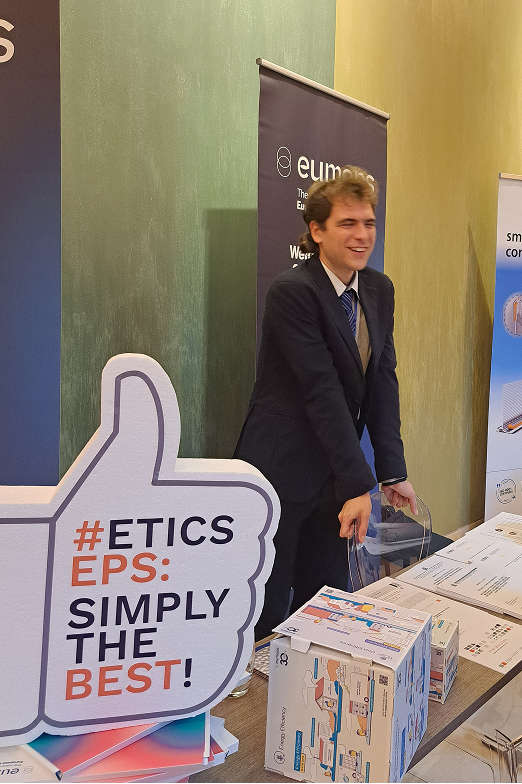
EUMEPS participated as sponsor and contributor, represented by Jakub Stefaniak, Emanuela Gallo and Bianca Sereinig. The association’s involvement highlighted the central role of expanded polystyrene (EPS) in façade insulation systems and its contribution to circularity, durability and affordable energy renovation. Jakub delivered a dedicated presentation on the contribution of EPS to circular, sustainable and durable ETICS, drawing on studies, data and practical experience from across Europe.
EPS and its contribution to circular, sustainable and durable ETICS
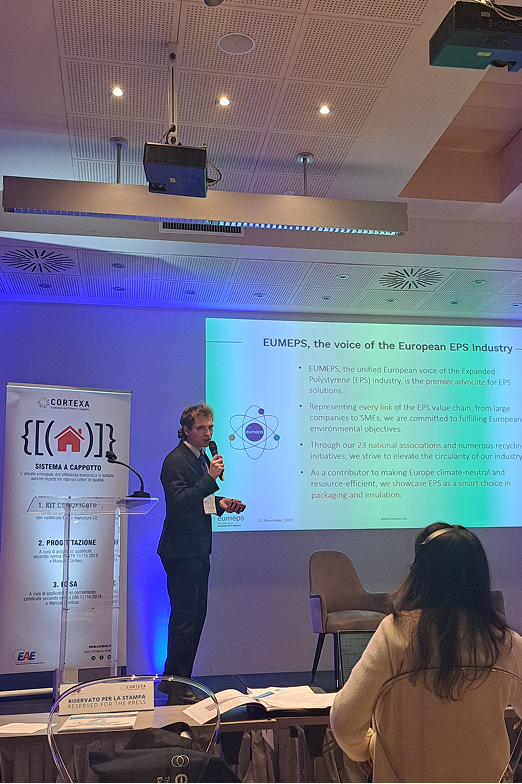 Jakub began by presenting the EPS value chain represented within EUMEPS: raw material suppliers, converters, recyclers, machinery suppliers and 23 national associations across Europe. He explained how EPS contributes simultaneously to the social, economic and environmental dimensions of sustainability.
On the social aspects, he underlined the direct impact of insulation on living conditions. EPS used in ETICS helps maintain stable indoor temperatures, reducing heat loss during winter and excessive overheating during summer. This leads to lower energy bills — often reduced by 30% to 50% — which is particularly relevant for older buildings and households facing energy poverty. A consistent indoor climate also reduces humidity and mould, improving public health and lowering healthcare costs. Jakub noted: “EPS helps reduce energy bills by 30% to 50% depending on the building, and it contributes to healthier indoor environments by preventing moisture and mould growth.”
On the economic dimension, EPS supports the renovation wave by offering a strong cost-to-thermal-performance ratio. Renovating Europe’s building stock stimulates local employment along the construction value chain and reduces energy consumption, strengthening national energy security. Data from EAE and Cortexa illustrated current trends: Italy, Poland, Romania and the Czech Republic remain the largest ETICS markets, and in 2024, EPS represented 77% of all ETICS insulation.
Environmentally, EPS offers several advantages. It is fully recyclable and compatible with mechanical, physical and chemical recycling technologies. Jakub presented evidence showing that the energy used to produce EPS is offset within approximately two years through energy savings during the lifecycle of the building. Studies also show that recycling can significantly reduce the global warming potential of EPS. Initiatives such as EPSolutely demonstrate practical solutions for reintegrating construction offcuts into production loops. Durability studies presented at the Forum confirmed that EPS maintains its mechanical properties even after decades of use, with examples of systems installed in the 1960s and 1970s still performing well today.
Key messages from the Forum: perspectives from the EUMEPS team
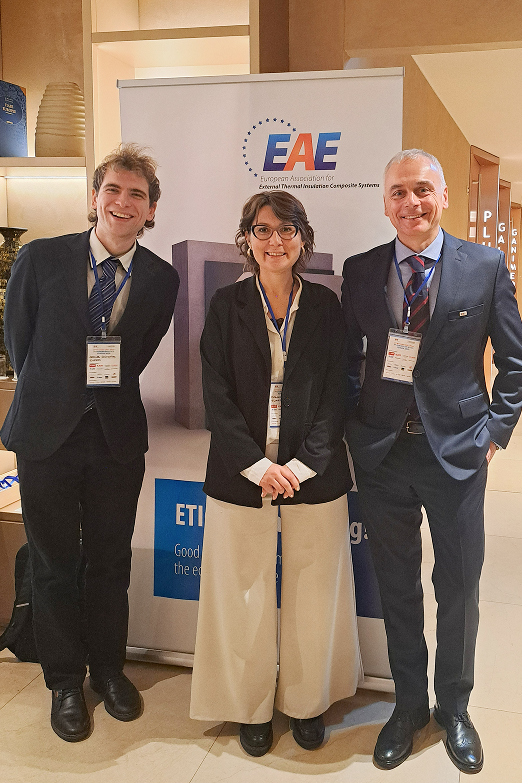 The Forum offered a broad set of insights on regulatory developments, market dynamics and technical performance across Europe. The EUMEPS delegation highlighted several elements as particularly relevant.
For Emanuela Gallo, the attendance of more than 200 participants reinforced the high level of interest in ETICS as a strategic solution for energy renovation and decarbonisation. She emphasised the value of the data presented by EAE and Cortexa, which provided a clear picture of Europe’s building stock, market shares, national differences and renovation needs. She remarked on the intervention by EU Commissioner Dan Jørgensen, who outlined the EU’s approach to energy efficiency and renovation policies. As she explained: “The large number of participants shows how central ETICS is to renovation, decarbonisation and sustainability.”
Bianca Sereinig highlighted the practical strengths of the event design. The format offered sufficient time for discussions, exchanges with system suppliers and high-quality interactions with participants from several countries. She noted a strong alignment across the sector on common priorities: energy efficiency, decarbonisation, circularity and affordable housing. In her view, the Forum confirmed that industry actors share a similar understanding of how ETICS can support the transition. She noted: “There is a common understanding in the ETICS sector on energy efficiency, decarbonisation, circularity and affordable housing. It was encouraging to see high interest in these topics from all sides.”
For Jakub Stefaniak, one of the central elements was the diversity of stakeholders and the growing international interest in ETICS. Participants came from multiple sectors and several national administrations. He noted a particularly strong presence from Italy, reflecting the importance of ETICS in the country’s renovation programmes. He also observed that the EPBD remains a key topic for both industry and authorities: “More and more stakeholders are showing interest in insulation and renovation. The EPBD clearly remains a key topic for industry and authorities.”
Looking ahead: expectations for the next edition
 The next edition of the European ETICS Forum will take place in two years, with the EAE Awards planned for 2026 to showcase ETICS projects from across Europe. The EUMEPS team expressed a common set of expectations linked to the evolution of EU policies and national renovation strategies.
All three representatives emphasised the importance of EPBD implementation, which is currently entering the phase of national transposition. The coming years will be decisive for defining funding mechanisms, technical requirements and support schemes to accelerate renovation. Jakub expects the next Forum to provide “more insight into EPBD implementation, with a focus on solutions for successful delivery on the ground.”
Bianca hopes to see concrete progress in applying energy-efficiency principles and the emergence of good practices across Member States, especially regarding circularity and end-of-life management of materials. She stressed the relevance of ETICS in making renovation more affordable and accessible: “In two years, I hope we can already present some good practices in EPBD implementation and show concrete progress on efficiency-first with ETICS.”
Emanuela highlighted the value of maintaining the Forum as a platform for collaboration and knowledge sharing. She expects the next edition to keep its focus on decarbonisation, circularity, affordability and renovation policy, while providing an opportunity to compare national approaches and encourage cooperation across the sector. As she stated: “The next Forum will be an opportunity to observe how EPBD implementation advances across countries and to continue exchanges that support collaboration.”
Conclusion
EUMEPS’s participation in the European ETICS Forum 2025 confirmed the strong relevance of EPS as a solution for circular, durable and efficient façade insulation. The event highlighted both the opportunities and challenges facing Europe’s renovation agenda, particularly in the context of EPBD implementation, decarbonisation objectives and housing affordability.
By engaging with policymakers, industry representatives and technical experts, EUMEPS contributed to a constructive exchange on how to accelerate renovation, strengthen circular practices and ensure long-term performance of ETICS systems. The next edition of the Forum will be an important moment to assess progress across Europe and continue building cooperation within the sector.

PPWR: the European Commission Publishes a New Guidance for Implementation
- Details
- Written by: Ingrid
- Category: News - Smart Packaging
- Hits: 166
- Documents:
- Document Name: Download the guidance, Document File: PPWR_Guidance_2026.pdf
- Links:
- Link title: Guidance document on Packaging and Packaging Waste Regulation (PPWR), Link URL: https://environment.ec.europa.eu/publications/guidance-document-packaging-and-packaging-waste-regulation-ppwr_en
- Link title: FAQ on Packaging and Packaging Waste Regulation (PPWR), Link URL: https://environment.ec.europa.eu/publications/faq-packaging-and-packaging-waste-regulation-ppwr_en
The European Commission has released a long-awaited Guidance document on the Packaging and Packaging Waste Regulation (PPWR), accompanied by a comprehensive FAQ. These documents provide important clarification for economic operators and Member States as they prepare for the implementation of this significant legislation.
Although the Guidance will be translated into all EU official languages before its formal adoption, it already offers valuable insight into how the Commission interprets key provisions. It is important to note that the document is non-binding; only the Court of Justice of the European Union can deliver legally binding interpretations.
Recyclability Requirements: Transition Continues
A central clarification relates to recyclability requirements. The Commission confirms that, until Article 6(2)(a) of the PPWR becomes applicable, manufacturers must continue complying with the existing Packaging and Packaging Waste Directive (PPWD) and the harmonised standard EN 13430:2004.
Importantly, no PPWR conformity assessment for recyclability is required at this stage. This obligation will only apply once the delegated acts under Article 6(4) enter into force. This transitional approach provides a degree of regulatory continuity while allowing time for the development of more advanced, resource-efficient and sustainable compliance frameworks.
Recycled Content: Direct Application of Exemptions
The Guidance also clarifies the application of exemptions under Article 7(5), confirming that these apply directly without requiring approval from the Commission or national authorities.
However, manufacturers are required to justify the use of such exemptions within their technical documentation. This includes providing evidence, such as the absence of authorised recycling technologies. For example, under Article 7(5)(a), documentation must clearly specify the polymer used for each plastic component representing at least 5% of the total packaging weight.
This approach reinforces the importance of transparent, high-performance documentation systems to support a more circular economy and ensure credible implementation of recycled content targets.
Labelling: Harmonisation Across the EU
Labelling provisions under Article 12 are designed to improve consumer sorting of packaging waste, supporting more efficient waste management systems.
The Guidance clarifies that these requirements primarily target consumer-facing packaging, rather than industrial or commercial packaging. A key confirmation is that Article 12 fully harmonises packaging labelling across the EU. As a result, Member States are not permitted to introduce additional mandatory national labelling requirements.
This harmonisation is expected to reduce fragmentation in the internal market, enabling more efficient and consistent communication to consumers while supporting energy-saving waste sorting practices.
Reuse of Transport Packaging: Practical Interpretation
Further clarification is provided on reuse requirements, particularly concerning “sales packaging used for transporting products” under Article 29.
The Guidance explains that the eligibility of such packaging for reuse depends on two main factors:
- The nature of the packaged product
- Whether the packaging clearly fulfils a transport function
Several practical examples are included in the document, offering economic operators clearer direction on how to assess reuse scenarios. This contributes to a more consistent and sustainable application of reuse systems across the EU.
Moving Towards a Climate-Neutral Packaging Framework
The publication of this Guidance represents an important step towards the effective implementation of the PPWR. While non-binding, it provides much-needed clarity that supports industry preparedness and regulatory alignment.
By addressing recyclability, recycled content, labelling, and reuse, the Commission is helping to create a more coherent and resource-efficient packaging framework. These measures are essential for advancing a circular economy and achieving climate-neutral objectives within the European packaging value chain.
As further delegated acts and translations become available, stakeholders will need to continue adapting to ensure compliance with this evolving regulatory landscape.
Page 1 of 2