
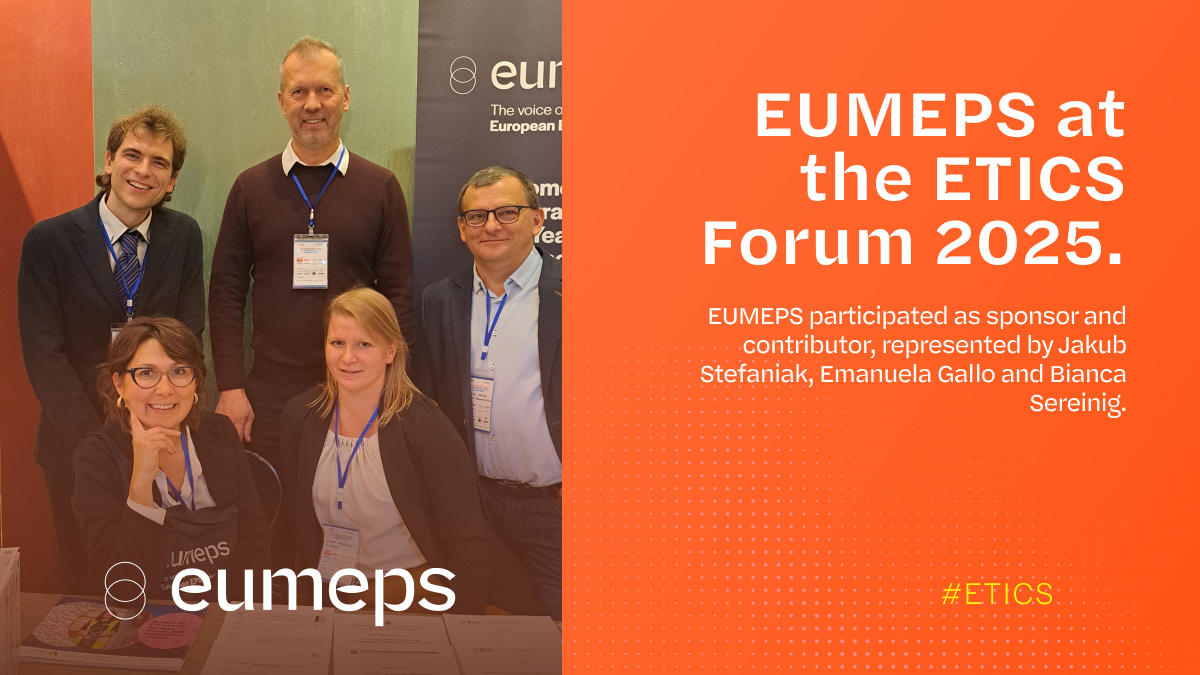
The 7th European ETICS Forum 2025, organised by the European Association for External Thermal Insulation Composite Systems (EAE), took place on 12 November in Milan. The event gathered more than 200 specialists, including architects, façade engineers, designers, contractors, policymakers, public authorities, researchers and manufacturers, press agents. Viewed as the main European platform dedicated to ETICS, the Forum offers a comprehensive overview of market trends, technical developments and regulatory priorities shaping the renovation of Europe’s buildings.
EUMEPS participated as sponsor and contributor, represented by Jakub Stefaniak, Emanuela Gallo and Bianca Sereinig. The association’s involvement highlighted the central role of expanded polystyrene (EPS) in façade insulation systems and its contribution to circularity, durability and affordable energy renovation. Jakub delivered a dedicated presentation on the contribution of EPS to circular, sustainable and durable ETICS, drawing on studies, data and practical experience from across Europe.
EPS and its contribution to circular, sustainable and durable ETICS
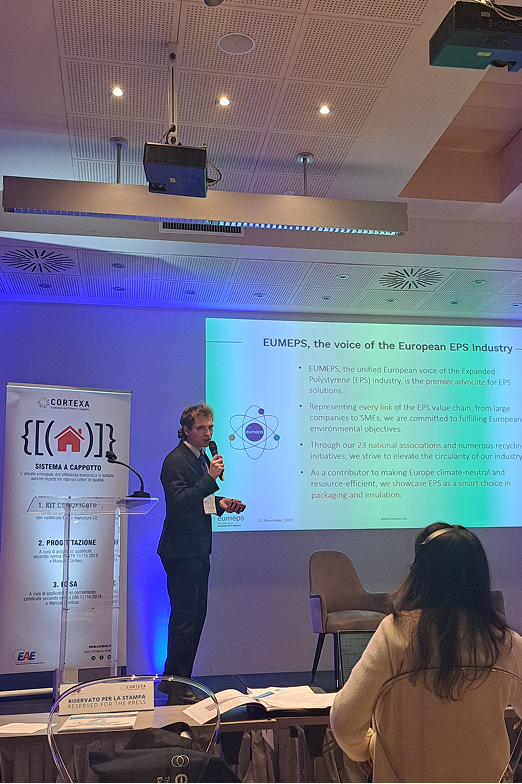 Jakub began by presenting the EPS value chain represented within EUMEPS: raw material suppliers, converters, recyclers, machinery suppliers and 23 national associations across Europe. He explained how EPS contributes simultaneously to the social, economic and environmental dimensions of sustainability.
On the social aspects, he underlined the direct impact of insulation on living conditions. EPS used in ETICS helps maintain stable indoor temperatures, reducing heat loss during winter and excessive overheating during summer. This leads to lower energy bills — often reduced by 30% to 50% — which is particularly relevant for older buildings and households facing energy poverty. A consistent indoor climate also reduces humidity and mould, improving public health and lowering healthcare costs. Jakub noted: “EPS helps reduce energy bills by 30% to 50% depending on the building, and it contributes to healthier indoor environments by preventing moisture and mould growth.”
On the economic dimension, EPS supports the renovation wave by offering a strong cost-to-thermal-performance ratio. Renovating Europe’s building stock stimulates local employment along the construction value chain and reduces energy consumption, strengthening national energy security. Data from EAE and Cortexa illustrated current trends: Italy, Poland, Romania and the Czech Republic remain the largest ETICS markets, and in 2024, EPS represented 77% of all ETICS insulation.
Environmentally, EPS offers several advantages. It is fully recyclable and compatible with mechanical, physical and chemical recycling technologies. Jakub presented evidence showing that the energy used to produce EPS is offset within approximately two years through energy savings during the lifecycle of the building. Studies also show that recycling can significantly reduce the global warming potential of EPS. Initiatives such as EPSolutely demonstrate practical solutions for reintegrating construction offcuts into production loops. Durability studies presented at the Forum confirmed that EPS maintains its mechanical properties even after decades of use, with examples of systems installed in the 1960s and 1970s still performing well today.
Key messages from the Forum: perspectives from the EUMEPS team
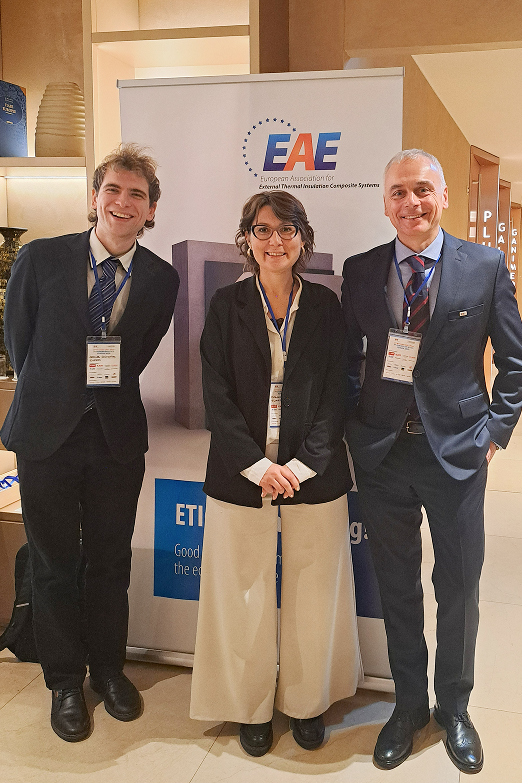 The Forum offered a broad set of insights on regulatory developments, market dynamics and technical performance across Europe. The EUMEPS delegation highlighted several elements as particularly relevant.
For Emanuela Gallo, the attendance of more than 200 participants reinforced the high level of interest in ETICS as a strategic solution for energy renovation and decarbonisation. She emphasised the value of the data presented by EAE and Cortexa, which provided a clear picture of Europe’s building stock, market shares, national differences and renovation needs. She remarked on the intervention by EU Commissioner Dan Jørgensen, who outlined the EU’s approach to energy efficiency and renovation policies. As she explained: “The large number of participants shows how central ETICS is to renovation, decarbonisation and sustainability.”
Bianca Sereinig highlighted the practical strengths of the event design. The format offered sufficient time for discussions, exchanges with system suppliers and high-quality interactions with participants from several countries. She noted a strong alignment across the sector on common priorities: energy efficiency, decarbonisation, circularity and affordable housing. In her view, the Forum confirmed that industry actors share a similar understanding of how ETICS can support the transition. She noted: “There is a common understanding in the ETICS sector on energy efficiency, decarbonisation, circularity and affordable housing. It was encouraging to see high interest in these topics from all sides.”
For Jakub Stefaniak, one of the central elements was the diversity of stakeholders and the growing international interest in ETICS. Participants came from multiple sectors and several national administrations. He noted a particularly strong presence from Italy, reflecting the importance of ETICS in the country’s renovation programmes. He also observed that the EPBD remains a key topic for both industry and authorities: “More and more stakeholders are showing interest in insulation and renovation. The EPBD clearly remains a key topic for industry and authorities.”
Looking ahead: expectations for the next edition
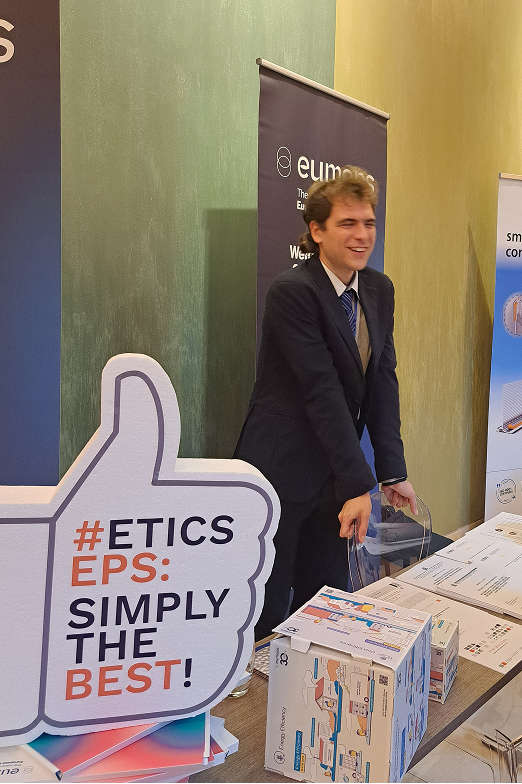 The next edition of the European ETICS Forum will take place in two years, with the EAE Awards planned for 2026 to showcase ETICS projects from across Europe. The EUMEPS team expressed a common set of expectations linked to the evolution of EU policies and national renovation strategies.
All three representatives emphasised the importance of EPBD implementation, which is currently entering the phase of national transposition. The coming years will be decisive for defining funding mechanisms, technical requirements and support schemes to accelerate renovation. Jakub expects the next Forum to provide “more insight into EPBD implementation, with a focus on solutions for successful delivery on the ground.”
Bianca hopes to see concrete progress in applying energy-efficiency principles and the emergence of good practices across Member States, especially regarding circularity and end-of-life management of materials. She stressed the relevance of ETICS in making renovation more affordable and accessible: “In two years, I hope we can already present some good practices in EPBD implementation and show concrete progress on efficiency-first with ETICS.”
Emanuela highlighted the value of maintaining the Forum as a platform for collaboration and knowledge sharing. She expects the next edition to keep its focus on decarbonisation, circularity, affordability and renovation policy, while providing an opportunity to compare national approaches and encourage cooperation across the sector. As she stated: “The next Forum will be an opportunity to observe how EPBD implementation advances across countries and to continue exchanges that support collaboration.”
Conclusion
EUMEPS’s participation in the European ETICS Forum 2025 confirmed the strong relevance of EPS as a solution for circular, durable and efficient façade insulation. The event highlighted both the opportunities and challenges facing Europe’s renovation agenda, particularly in the context of EPBD implementation, decarbonisation objectives and housing affordability.
By engaging with policymakers, industry representatives and technical experts, EUMEPS contributed to a constructive exchange on how to accelerate renovation, strengthen circular practices and ensure long-term performance of ETICS systems. The next edition of the Forum will be an important moment to assess progress across Europe and continue building cooperation within the sector.