
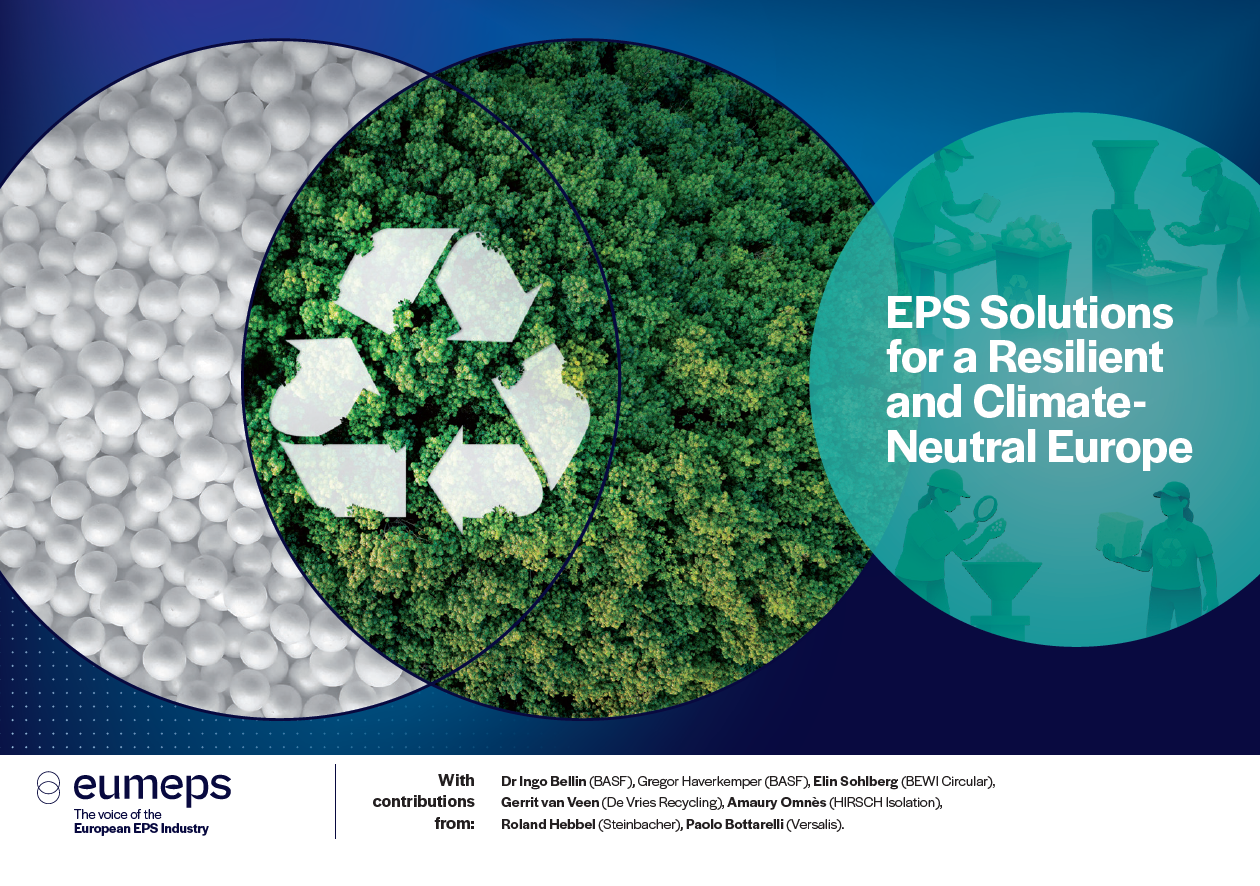
New publication: "EPS Solutions for a Resilient and Climate-Neutral Europe"
How can the European EPS industry contribute to the European Union's climate, circular economy and industrial objectives? What practical initiatives are already being implemented across Europe to improve recycling, increase resource efficiency and support more sustainable construction and packaging?
These are some of the questions addressed in EUMEPS' latest publication, EPS Solutions for a Resilient and Climate-Neutral Europe.
Developed as a reference document for policymakers, industry stakeholders and members, the publication brings together concrete examples from across the European Expanded Polystyrene (EPS) value chain. Rather than presenting sustainability as a future ambition, it highlights projects, investments and collaborative initiatives that are already delivering measurable results throughout Europe.
The publication explains how EPS contributes to several key European policy priorities, including energy efficiency in buildings, circular economy objectives, industrial competitiveness and resource efficiency. It also examines the policy context surrounding the material, including the Energy Performance of Buildings Directive (EPBD), the Packaging and Packaging Waste Regulation (PPWR) and the Clean Industrial Deal.
Throughout the publication, readers will discover a series of practical case studies illustrating how companies and organisations are translating these objectives into action. Among the initiatives featured are EPSolutely, a collaborative research project coordinated by Fraunhofer Austria to develop advanced recycling solutions for EPS, PS Loop, which demonstrates the value of cooperation across the entire EPS value chain, and the Malta Project, an initiative exploring practical solutions for improving EPS collection and recycling in island regions. The publication also highlights Operation Clean Sweep®, illustrating the industry's commitment to preventing pellet loss throughout the plastics value chain.
Alongside these projects, the brochure presents numerous examples of industrial investment in recycling infrastructure, the use of recycled raw materials, product innovation and certification schemes. It also features testimonials from industry representatives and scientific evidence demonstrating the technical performance and recyclability of EPS under realistic industrial conditions.
By bringing these initiatives together in a single publication, EUMEPS aims to provide policymakers and stakeholders with a fact-based overview of the progress already achieved by the European EPS industry. The publication illustrates how collaboration between raw material producers, converters, recyclers, researchers and national associations is helping to support Europe's transition towards a more circular, competitive and climate-neutral economy.
We invite you to explore the publication and discover how the European EPS value chain is contributing to sustainable solutions across construction, packaging and recycling.