
Summer Comfort and Insulation: Understanding the Key Factors
 As heatwaves become more frequent and intense across Europe, summer comfort has become a key consideration in building design and renovation. At the same time, misconceptions about the role of insulation continue to circulate in the media and public debate. One of the most common claims is that only heavy or high-density insulation materials can effectively protect buildings from overheating, while lightweight materials such as expanded polystyrene (EPS) are often perceived as less suitable for summer conditions.
In reality, summer comfort is determined by the performance of the building as a whole rather than by the properties of a single material. Thermal resistance, thermal mass, ventilation, solar protection, airtightness and the overall design of the building envelope all interact to influence indoor temperatures.
This article explains the principles behind summer thermal comfort, clarifies the concept of thermal time lag and reviews the scientific evidence on the factors that have the greatest influence on indoor temperatures. It also highlights the role that EPS insulation can play as part of a well-designed building envelope, contributing to comfortable indoor environments throughout the year.
Does insulation contribute to summer comfort?
Yes. Although EPS is primarily recognised for its winter thermal insulation performance, it also contributes to summer comfort by limiting heat transfer through building elements. In particular, when used in an External Thermal Insulation Composite System (ETICS), EPS protects the thermal mass of the external wall from external temperature fluctuations, thereby helping to stabilise the internal temperature of the building during periods of hot weather.
Key point: The higher the thermal resistance of the EPS insulation, the better the summer comfort.
How can the summer comfort of a building insulated with EPS be improved?
Several complementary measures can be implemented: retain or enhance the thermal mass of internal building elements, such as concrete and brick; ensure effective night-time ventilation to remove accumulated heat; use external solar protection devices, such as shutters and solar shading; and ensure good airtightness of the building envelope to prevent heat gains through air infiltration.
What influences summer comfort?
 Summer comfort depends on much more than insulation alone. The orientation of a building, its thermal mass, ventilation strategy, solar protection and the overall design of the building envelope all influence indoor temperatures during periods of hot weather. Understanding how these factors interact is essential for designing buildings that remain comfortable without relying excessively on mechanical cooling.
New Build: Orientation, Thermal Mass, Ventilation and Insulation
A new-build project allows you to anticipate summer comfort issues from the design stage, which is a real advantage. Many factors influence the behaviour of a dwelling during the summer. Here, we will focus on all the techniques that make it possible to avoid the need for air conditioning. Let us look at the main ones.
Orientation
A determining factor in the solar exposure and daylighting of your home, orientation serves two objectives: capturing solar heat gains in winter and limiting direct solar radiation in summer. Glazed areas should be positioned so as to fulfil both of these objectives.
For example, in France, RT 2012 requires a minimum glazed area of at least one-sixth of the habitable floor area (1 m² of glazing for every 6 m² of habitable floor area). However, care should be taken not to exceed a glazing ratio of 25%, otherwise overheating of the glazed openings may become uncomfortable.
Openings facing east and west, which are exposed to direct solar radiation, should be fitted with solar protection measures such as blinds, shutters or roof overhangs. Ideally, these protection measures should be adjustable to adapt to climatic conditions and levels of solar exposure. The use of solar control glazing may also be considered for the most exposed glazed openings.
By contrast, south-facing openings are not exposed to direct solar radiation during the hottest part of the day and allow maximum solar heat gains to be captured in winter without compromising summer comfort. They also help to reduce the need for artificial lighting, thereby delivering energy savings.
Finally, do not forget to take prevailing winds into account. Depending on your location, you may benefit from the natural cooling provided by this inexhaustible and free resource.
Tip: Another point to consider, which is indirectly linked to orientation, is the colour of the external façade render. Choose light-coloured finishes, as they reflect more solar radiation and allow your home to absorb less heat.
Thermal Mass of Building Elements
What does this mean? Thermal mass is the ability of a building element to store heat and release it at a later time.
A building with high thermal mass will accumulate heat within its building elements (external heat resulting from air temperature or solar radiation, or internal heat generated by heating systems or the use of appliances) and release it indoors several hours later. The time taken for heat to transfer from one side of the building element to the other is known as the time lag. In summer, a long time lag allows the coolness accumulated overnight to be released gradually throughout the day. In winter, a building element with high thermal mass takes longer to warm up but continues to release heat into the dwelling for a longer period after the heating has been switched off.
As you will have understood, the purpose of a building element with high thermal mass is to smooth out temperature fluctuations, thereby maintaining consistent indoor comfort and reducing heating requirements.
To achieve this objective, attention should first be paid to the building structure and the materials from which it is constructed. In conventional construction, solid, dense materials—such as concrete, solid brick and stone—should be preferred in order to maximise the thermal mass of the building element. Timber-frame buildings can also achieve good thermal mass, but the lower structural mass must be compensated for by using dense, heavy insulation materials. Masonry lining walls may also be added.
Ventilation
The third important factor in achieving summer comfort is ventilation, which should not be overlooked. It may be provided naturally or mechanically and can reduce the internal temperature of a dwelling by between 2 and 5°C.
Natural ventilation—particularly night-time ventilation—combined with good thermal mass, allows both the indoor air temperature and the temperature of the building elements to be reduced. The building elements can then store this coolness and release it during the day, provided that the time lag is sufficient. This can be achieved simply by opening the windows at night. Automating the opening of glazed openings allows periods of opening and closing to be managed more precisely and maximises the effectiveness of ventilation.
The design of the internal layout also has a role to play: dual-aspect rooms allow better air circulation and more effective cooling.
Mechanical ventilation offers solutions that are more economical than air conditioning. Air circulators (fans) are a simple but effective option. The installation of a mechanical ventilation system, preferably a mechanical ventilation with heat recovery (MVHR) system, should also be considered, as increasing the internal air velocity is an important factor in achieving summer comfort.
Finally, a ground-to-air heat exchanger, which uses the coolness of the ground, is a highly energy-efficient and very effective solution.
Good airtightness is equally essential. Neither high-performance ventilation nor high-performance insulation can achieve their full potential without a well-sealed building envelope. Poor airtightness allows unwanted heat transfer between the interior and exterior, reducing thermal comfort and increasing energy demand..
What about insulation?
Insulation is, of course, a factor that must be taken into account when considering summer comfort. The overall thermal resistance of the building elements plays an important role in limiting heat transfer. Installing high-performance insulation is therefore an essential prerequisite, with a positive impact on comfort in both summer and winter.
Although insulation is not intended to provide the thermal mass of a building element (except in timber-frame construction), it nevertheless contributes to it. In particular, the position of the insulation has a significant influence on thermal mass: external thermal insulation (ETICS) should be preferred, as it delivers better performance than internal insulation for the same building element thickness.
Finally, insulation helps to eliminate thermal bridges. Thermal bridges in floors, walls or roofs will reduce the thermal mass performance of a building element if they are not properly addressed. An ETICS (External Thermal Insulation Composite System) provides an effective solution. For floors, the use of insulating EPS beam-and-block floor infill units is also an effective solution (together with thermal break elements where internal insulation is used). For flat roofs, insulation installed above the structural deck should be preferred.
What about refurbishment?
In a refurbishment project, the orientation and structure of the building are generally fixed. The main opportunities for improving summer comfort therefore lie in upgrading the building envelope and reducing unwanted heat gains.
- Glazed areas: Windows are often the weakest part of the building envelope in terms of thermal performance. In winter, they provide less insulation than opaque building elements. In summer, they are directly exposed to solar radiation and can become a major source of heat gains. Replacing single glazing with high-performance glazing can improve comfort throughout the year. Solar control glazing may also be considered for the most exposed façades.
- Solar protection: As with new-build construction, external solar protection devices such as blinds, shutters or brise-soleil can significantly reduce direct solar gains, particularly on east- and west-facing façades.
- Insulation: Installing an External Thermal Insulation Composite System (ETICS) remains one of the most effective ways of preserving the thermal mass of the building structure. Ideally, high thermal mass materials such as concrete or masonry walls, as well as concrete floor or roof slabs, should remain on the interior side of the insulation, where they can help stabilise indoor temperatures.
- Ventilation: As in new-build construction, ventilation deserves particular attention during refurbishment. Whether manual or automated, effective night-time ventilation plays an important role in removing accumulated heat and improving indoor comfort.
- Internal heat gains: Finally, occupant behaviour also influences summer comfort. Household appliances such as computers, ovens, hobs, tumble dryers and televisions all generate heat. During hot weather, limiting their use where possible—and avoiding unnecessary internal heat gains—can help reduce indoor temperatures. Combined, these heat sources may increase indoor temperatures by up to 5°C.
What is thermal time lag?
 Thermal time lag is the time required for a temperature variation at the external surface of a building element to be transmitted to its internal surface. Put simply, it is the time taken for heat to pass through a building element. The longer the thermal time lag, the better the summer comfort, as external heat reaches the interior later in the day or during the night, when outdoor temperatures are lower and natural ventilation is possible. Thermal time lag must always be assessed in relation to the building element as a whole, taking into account its design and orientation
A long thermal time lag is the result of good thermal mass within the building element, which is characterised by its thermal diffusivity. Thermal diffusivity depends on several material properties:
- Thermal conductivity
- Density
- Specific heat capacity
- Thickness
However, thermal time lag is not the only indicator of good summer comfort. Another important parameter is the decrement factor, which refers to the ability of a building element to reduce indoor temperature fluctuations. The chosen construction method is also important. For example, an External Thermal Insulation Composite System (ETICS) generally provides better use of the building's thermal mass than internal insulation.
Priority should therefore be given to achieving high thermal resistance and adopting a bioclimatic approach to the design of both the building elements and the building as a whole
Does expanded polystyrene (EPS) provide good thermal time lag?
Expanded polystyrene (EPS) is a lightweight material consisting of approximately 98% air and 2% solid material. By its nature, this low-density material (typically between 10 and 40 kg/m³) does not, on its own, provide a high level of thermal time lag. However, thermal time lag should not be assessed by considering the insulation material alone, but rather the complete building element, including its structure, linings and finishes.
In the wall constructions commonly used in new-build buildings—brick or concrete block walls finished with rendered EPS insulation systems and plasterboard internal linings—the thermal time lag of the building elements can reach almost 13 hours. Even timber-frame wall constructions can achieve thermal time lags of more than 10 hours.
Does insulation density really determine summer comfort?
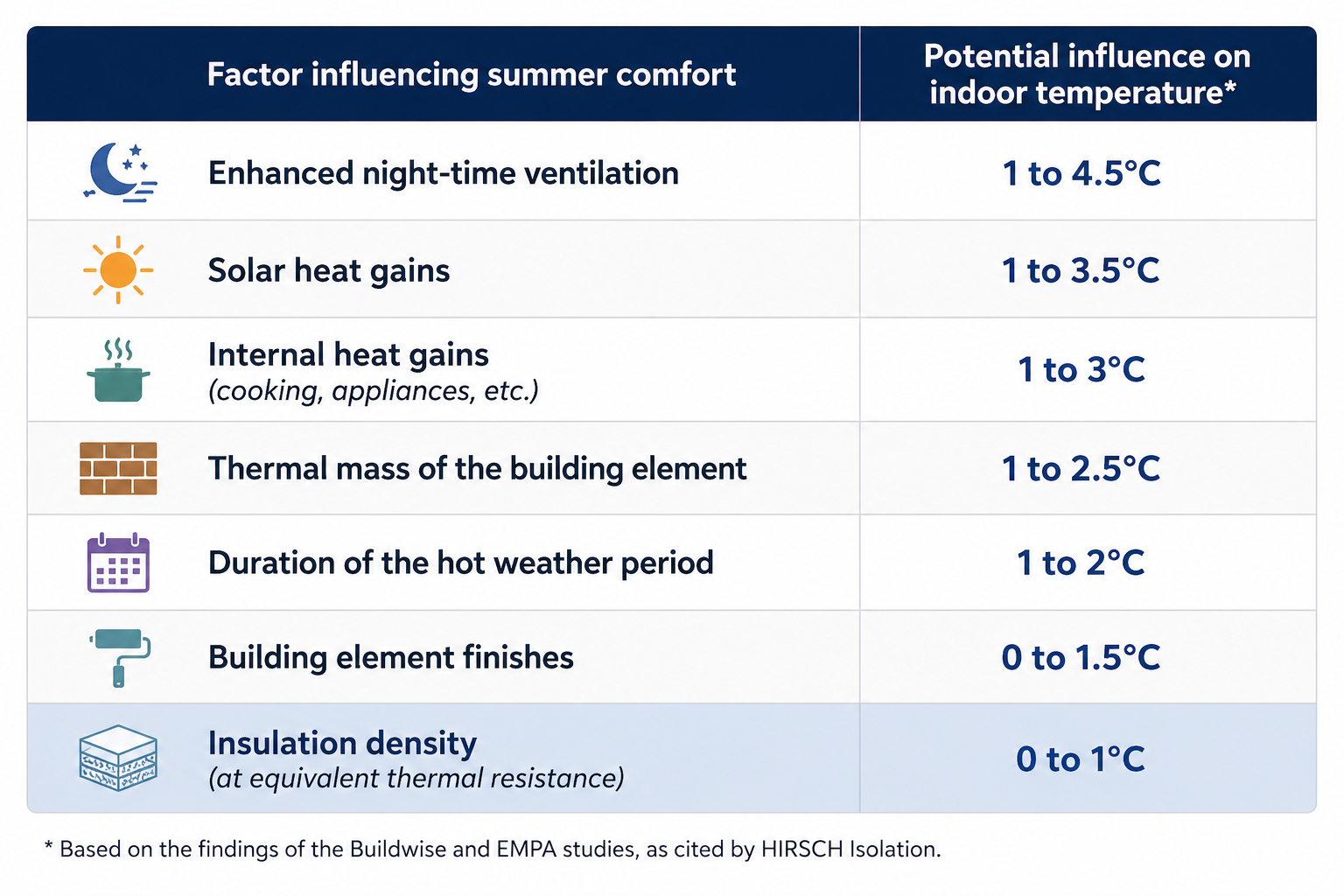
Contrary to a widely held belief, the type of insulation has little influence on the overall thermal time lag of a building element and, more generally, on summer comfort. Two studies (Buildwise and EMPA) have shown that, at equivalent thermal resistance, insulation materials with different densities do not result in any significant variation in the internal temperature of a building (from 0 to 1°C according to the EMPA study).
The thermal mass of the building element has a much greater influence (from 1 to 2.5°C), as do the following factors:
Thermal insulation, however, significantly limits solar heat gains. The thermal resistance of the insulation installed therefore plays a more important role than its density in achieving summer comfort.
In this respect, the thermal performance of expanded polystyrene (EPS) makes it a suitable material for summer comfort. When incorporated into a construction system providing high thermal time lag and a favourable decrement factor, and installed at sufficient thickness, it helps to maintain stable indoor temperatures in both summer and winter. It should also be noted that, even in timber-frame construction, certain configurations already used by housebuilders can achieve thermal time lags of more than 10 hours using expanded polystyrene insulation in external walls (source: UBAKUS calculations).
These findings show that summer comfort cannot be assessed by considering insulation density alone. Instead, it results from the combined performance of the building envelope, thermal mass, solar protection, ventilation and adequate thermal resistance. Within this holistic approach, EPS contributes effectively to maintaining comfortable indoor temperatures throughout the year.
Source:
Key takeaways
- Summer comfort depends on the performance of the whole building.
- High thermal resistance is more important than insulation density.
- Thermal time lag should always be assessed for the complete building element.
- Thermal mass, ventilation and solar protection are major contributors to indoor comfort.
- EPS contributes to comfortable indoor temperatures in both summer and winter when integrated into a well-designed building envelope.
Conclusion
There is no single solution for achieving summer comfort. Comfortable buildings result from the combined performance of insulation, thermal mass, solar protection, ventilation, airtightness and thoughtful building design.
Scientific studies consistently show that insulation density alone is not a reliable indicator of summer performance. Instead, the overall design of the building envelope and the thermal resistance of the insulation have a far greater influence on indoor comfort. When integrated into an appropriate construction system, EPS effectively limits heat transfer, preserves the benefits of thermal mass and contributes to stable indoor temperatures during both summer and winter.
As Europe continues to adapt its building stock to a changing climate, adopting a whole-building approach based on proven building physics rather than common misconceptions will be essential to delivering energy-efficient, resilient and comfortable buildings.
Source:
- https://hirschisolation.fr/faq/le-pse-contribue-t-il-au-confort-dete/
- https://hirschisolation.fr/faq/comment-ameliorer-le-confort-dete-dun-batiment-isole-en-pse/
- ICEB-ARENE Passive Summer Comfort Guide – Effinergie
- EMPA study Summer Thermal Protection of Rooms Located beneath Roof Spaces
- https://hirschisolation.fr/confort-thermique-dete-les-cles-pour-un-logement-performant/
- https://hirschisolation.fr/faq/quest-ce-que-le-dephasage-thermique-et-quelle-est-sa-valeur-pour-le-pse/
- https://hirschisolation.fr/faq/le-polystyrene-expanse-a-t-il-un-bon-dephasage/
- https://hirschisolation.fr/isolation-et-dephasage-halte-idees-recues/
Credit for the pictures: HIRSCH Isolation