
This article was originally published in French by Citeo on 7 January 2026.
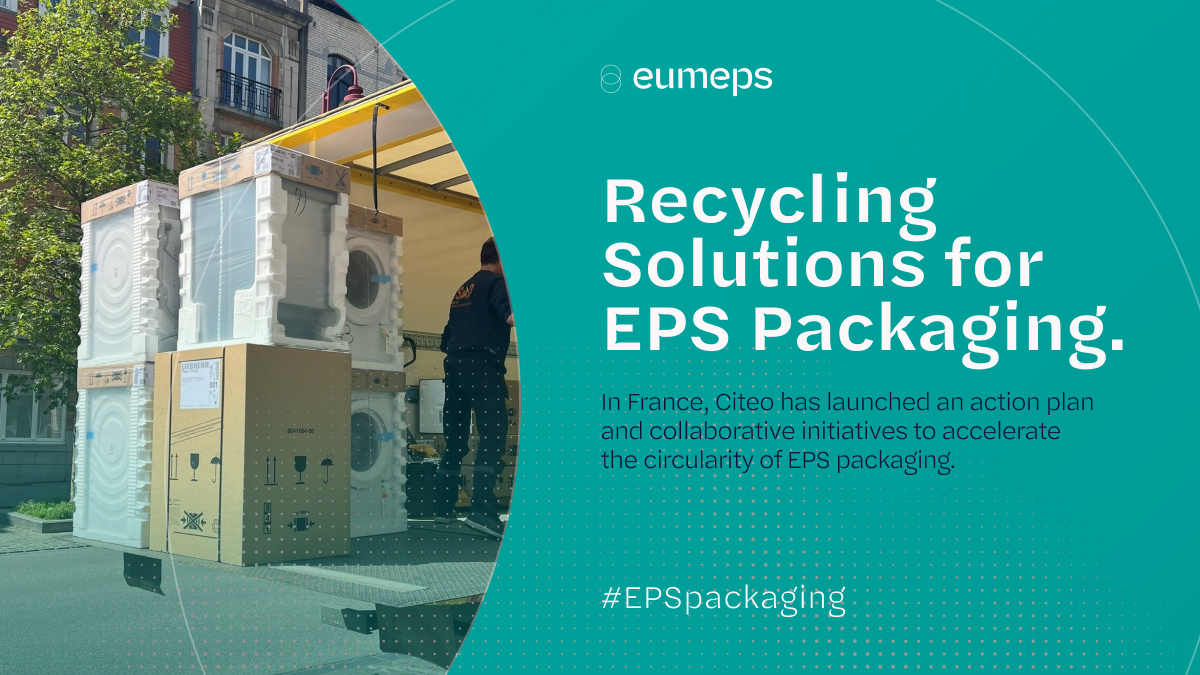
Expanded polystyrene (EPS) is a lightweight, economical and resistant material used mainly to manufacture protective packaging components for household electrical appliances. It represents around 15,000 tonnes of household packaging per year in France, i.e. 15% of styrenic packaging placed on the market. Like all packaging materials, EPS must meet recyclability requirements by 2030, which represents a major challenge. What are the obstacles and the solutions being considered? We explain.
EPS packaging that is difficult to collect and capture
Less than 20% of EPS packaging is sorted by citizens via the yellow bin, despite the widespread communication about the opening of the yellow bin to all packaging, including all plastic packaging. This striking figure can be explained in part by the large size of protective packaging for household appliances (refrigerators, washing machines, televisions, etc.). The consequences are as follows:
- In the majority of cases, EPS packaging is not sorted, and is sometimes even left at the foot of bins and sorting containers.
- When it is sorted, this bulky packaging quickly fills the yellow bin and tends to fragment into small pieces, making it difficult to capture in sorting centres.
- Another practice also makes capture difficult: citizens do not systematically separate all the elements of the packaging or parcels they receive. Upon arrival at the sorting centre, large EPS protective elements are very frequently found nested inside large cardboard boxes. This prevents the recovery and therefore the recycling of both the EPS protective packaging and the cardboard.
Furthermore, at the end of the sorting process, EPS is often degraded and fragmented and has no dedicated outlet. Only mixed recycling solutions with other polystyrene packaging could be considered but, to date, recyclers accept EPS only in very low proportions (less than 5%).
A four-axis strategy towards reduction and circularity
The objective is clear: to enable EPS packaging to be genuinely recycled and to achieve a recycling rate of more than 50% in the medium term. To reach this objective, Citeo has adopted an action plan combining reduction and eco-design, as well as complementary collection schemes to the yellow bin, in order to enable dedicated EPS recycling.
Reduction and eco-design of packaging. Research focuses on improving the recyclability of plastic foams, reducing friability through design, and developing alternatives, notably based on fibrous materials. Examples include moulded cellulose protective packaging developed by AVEC and cellulose-based foams designed by the Technical Centre for Paper, which are compatible with the paper and cardboard packaging stream.
Roll-out of collection at waste recycling centres. This is a solution adapted to the large dimensions of EPS packaging. A trial launched in 2023 with 13 local authorities shows encouraging results: more than 600 tonnes collected across 200 waste recycling centres. Around 15% of French waste recycling centres are already equipped to collect EPS, a system that Citeo is calling to be rolled out more widely.
Take-back of packaging at delivery. This system makes it possible to collect EPS protective packaging directly at the time of delivery of equipment to consumers. Source separation preserves material quality and facilitates recycling. The pilot study conducted in 2024 with the main retailers confirms the relevance of this approach, which can build on the deployment of extended producer responsibility (EPR) for professional packaging from 2026.
Improvement of capture in sorting centres. Efforts to improve the overall capture performance in sorting centres are continuing, even if prospects for EPS remain limited. For EPS packaging that is captured, discussions with PS recyclers are ongoing in order to enable its effective recycling.
The challenges associated with the recycling of expanded polystyrene packaging clearly highlight the need for coordinated action across the entire value chain, from eco-design and collection to sorting and recycling. While EPS presents specific technical and logistical constraints, the solutions outlined demonstrate that pragmatic and scalable pathways towards circularity are emerging.
In this context, EUMEPS, working in close cooperation with Citeo within the framework of CreaStyr, actively supports the development of innovative, technically robust and economically viable recycling solutions for polystyrene. By fostering dialogue between producers, recyclers, local authorities and technical experts, this collaboration aims to accelerate progress towards higher recycling rates, improved material quality and compliance with European recyclability objectives.
Advancing the circularity of EPS packaging will require continued investment, experimentation and collective commitment. EUMEPS remains fully engaged in contributing its expertise to help transform ambition into operational reality and ensure that polystyrene packaging can play a sustainable role in tomorrow’s circular economy.