

EUMEPS member Knauf Industries has achieved a score of 77/100 in its 2026 EcoVadis assessment, marking a further step forward in the company’s corporate social responsibility (CSR) journey and bringing it closer to an EcoVadis Gold Medal.
The result reflects the steady progress made by Knauf Industries over several years* and its continued work to integrate environmental, social and ethical considerations across its operations and value chain.
EcoVadis evaluates companies across four key areas: Environment, Labour & Human Rights, Ethics, and Sustainable Procurement. For Knauf Industries, the latest result reflects sustained efforts to strengthen responsible practices across their operations and value chain, while responding to growing expectations from customers, partners and stakeholders.
Knauf Industries also underlines that it is assessed under the L scope, which corresponds to a more comprehensive and demanding assessment framework. With a broader questionnaire and more stringent evaluation criteria, this scope gives additional significance to the score achieved and reflects the level of maturity reached by the company’s CSR management approach.
The company stresses that this progress is the result of a collective effort across the organisation. The improvement in the EcoVadis score has relied on the involvement of multiple teams and functions, including operations, procurement, HR, compliance, quality and sustainability. This cross-functional mobilisation has helped strengthen internal processes, improve documentation and monitoring, and embed CSR considerations more consistently into day-to-day decision-making.
The actions contributing to the improvement of this score are closely linked to our CSR approach, through the deployment of our sustainability roadmap. Since 2021, more than 100 projects have been implemented in areas including carbon footprint reduction, waste reduction, water consumption reduction, energy efficiency, and the development of alternative raw materials. Alongside these environmental initiatives, Knauf Industries also continues to strengthen its social commitments through a policy focused on talent and skills development, performance, and attractiveness in a forward-thinking working environment.
This progress has been driven through agile coordination led by Sophie Sissler, Sustainability Program Manager, together with the strong involvement of teams across the organisation.
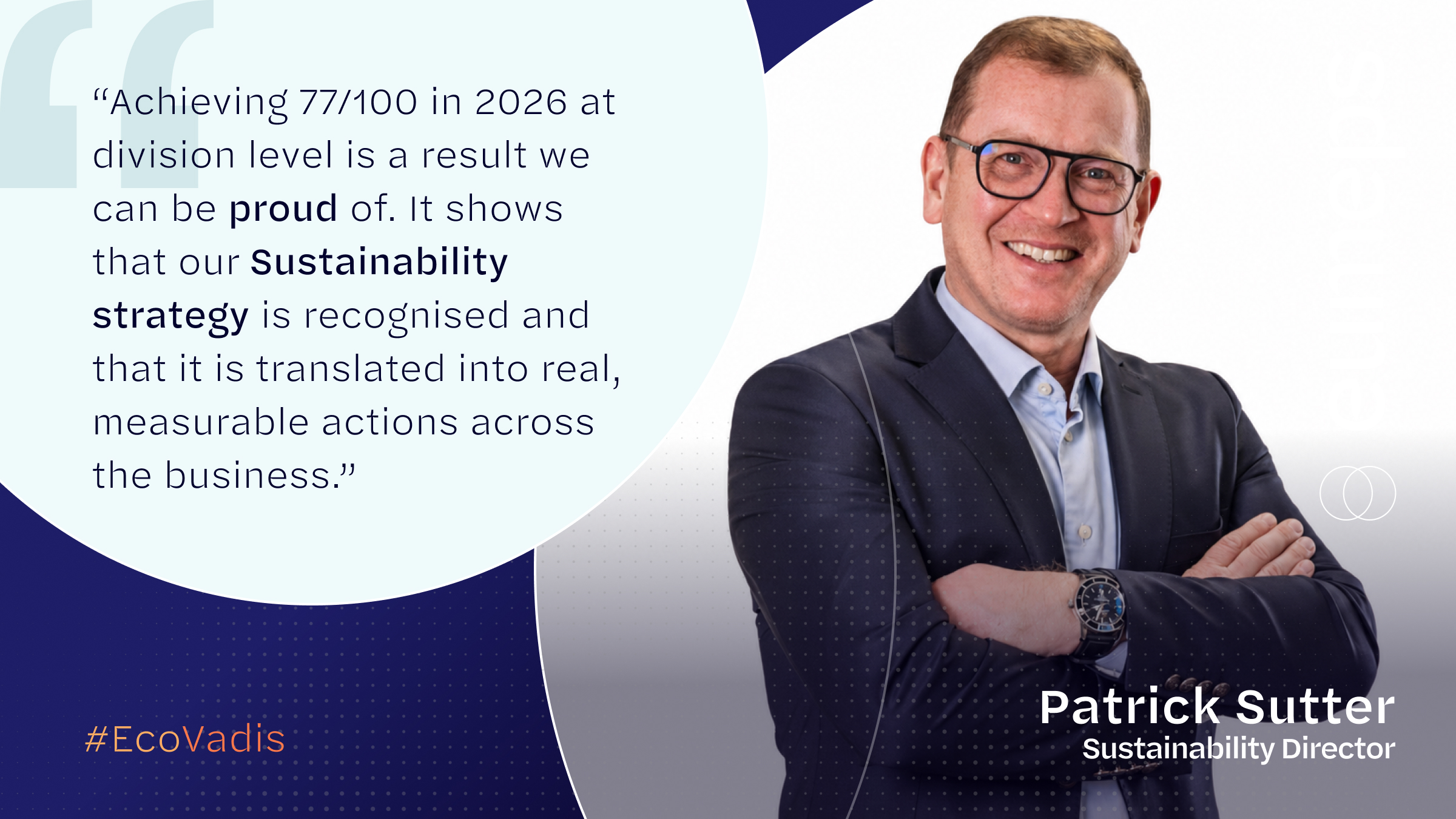
“Achieving 77/100 in 2026 at division level is a result we can be proud of. It shows that our Sustainability strategy is recognised and that it is translated into real, measurable actions across the business. This progress is clearly a collective achievement. I am proud of the engagement shown by our employees on this strategic topic, and I would also like to highlight the agile way in which this work has been coordinated by Sophie and the teams involved,” said Patrick Sutter, Knauf Sustainability Director and EUMEPS Converter Director.
Beyond recognition, EcoVadis remains an important management tool for Knauf Industries. It helps the company monitor progress, identify further areas for improvement, and continue embedding sustainability, responsibility and transparency into its business practices.
With this latest result, Knauf Industries confirms its commitment to continuous improvement and to advancing a robust and credible strategy in an increasingly demanding business environment.
*Knauf Industries scored 38/100 in 2018, before improving to 51/100 in 2020, 60/100 in 2021, 64/100 in 2023, 71/100 in 2024, 75/100 in 2025, and now 77/100. The company was awarded a Bronze Medal in 2020 and a Silver Medal in 2022, illustrating the steady strengthening of its CSR approach and, more broadly, its Sustainability strategy.
As a member of EUMEPS, Knauf Industries contributes to the efforts undertaken across the EPS value chain to strengthen environmental performance, responsible business practices and transparency.
Its latest EcoVadis result illustrates how structured sustainability strategies, supported by measurable actions and coordination across business functions, can contribute to continuous progress.